BB(ASCP) Exam Prep - Courses, Study Materials and Question Banks
MLSIA BB(ASCP) Exam Prep gives you clear direction, focused transfusion medicine study tools, and expert support that turn stress into steady control. Strengthen your confidence with guided resources, targeted practice, and structured plans that keep you safe and fully prepared.
BB(ASCP) Prep Courses, QBanks, and Study Materials
Every material is built to sharpen your blood banking mastery and move you closer to the BB(ASCP) credential that advances your laboratory career. Step into the exam calm, ready, and empowered to succeed.
$319.00Original price was: $319.00.$299.00Current price is: $299.00.
⭐Real Reviews & Testimonials⭐
Srividya badri
Verified Buyer
5/5
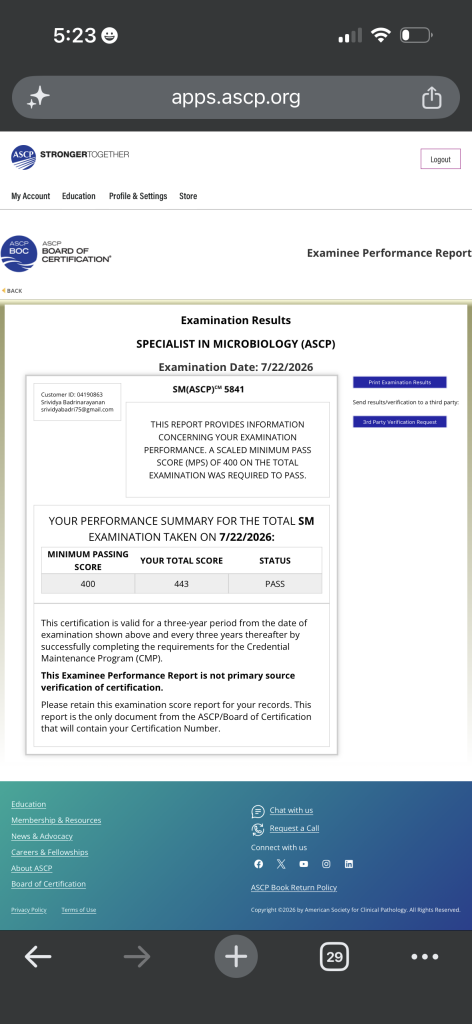
Highly recommend MLSIA Academy! I just passed my SM(ASCP) exam and couldn't have done it without this course. The high-yield study guides and realistic practice questions prepared me perfectly for the exam layout. The curriculum is concise, relevant, and worth every penny. Five stars!
MLS Academy is an excellent investment for anyone taking the SM(ASCP) exam. The depth of the microbiology content and management modules is fantastic. What sets this program apart is the quality of the resources and the responsiveness of the instructors. They truly care about student success. Thanks to their preparation tools, I felt confident going into the testing center and passed!
I enrolled in the MLSIA ASCP program to prepare for my certification exam. the lectures are organized and easy to follow and the study materials have helped me understand topics more clearly. I especially like having everything in one place. I am still preparing for my exam but so far the program has been very helpful.
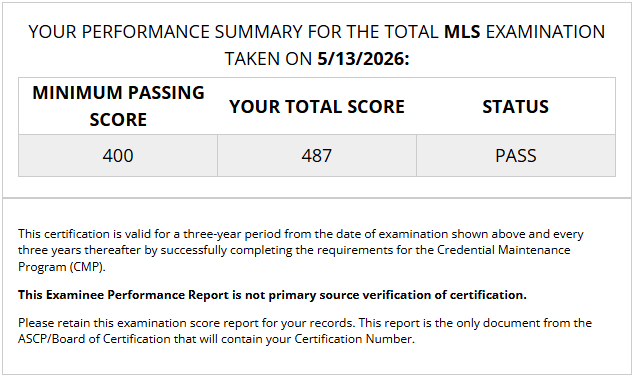
This course was the keystone to passing the MLS(ASCP) exam on 5/13/2026. I took the exam 3 times before taking the course. I found it to be a great help in bridging the gaps in the information. Its a hard exam with a lot of information. Before the MLSIA prep course i was using the Orange book and Labce but that wasn't enough. I felt i was just memorizing information rather than learning to understand. This prep course gave full lectures with all the information needed. The online quizzes are very nice.
highly recommend if you feel you lack a lot of the necessary knowledge.
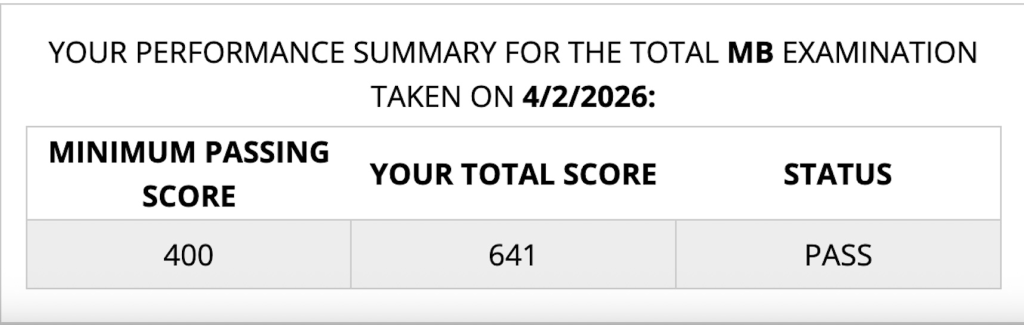
I passed exam with 641 score. The Q&A question bank for the preparation of MB-ASCP examination helped me greatly to solve many questions. However, the questions were not the same, but they helped me to select the topics and understand the content.
BB(ASCP) Exam Prep prepares candidates for the ASCP Board of Certification Blood Banking (BB) examination, which validates the competency of a Blood Bank Scientist or Blood Bank Technologist to independently perform and interpret immunohematology testing, support transfusion therapy, and manage blood bank workflows within a clinical laboratory setting.
This certification is designed for professionals whose primary scope of practice is blood banking and transfusion services, including candidates qualifying through experience-based eligibility routes, formal laboratory education pathways, or international laboratory training recognized by ASCP.
The BB(ASCP) exam confirms readiness to function beyond entry-level generalist testing while remaining within the scientist/technologist role, not the specialist or consultative level assessed by SBB(ASCP).
BB(ASCP) Exam Content Areas & BB Preparation Focus
Every BB(ASCP) prep module for the BB exam is fully aligned with the official ASCP guidelines for the [current_date format='Y']BB(ASCP) Blood Banking Scientist Exam.
The BB(ASCP) certification exam is organized around core transfusion medicine and blood banking domains defined by the ASCP Board of Certification. These domains, most recently updated for the [current_date format='Y'] , reflect the knowledge, technical skills, and clinical judgment required for safe and effective management of blood products. The focus is on blood component handling, compatibility testing, serologic and molecular assays, transfusion practice, and quality control, rather than general laboratory procedures or molecular/microbiology techniques.
Content Area
Description
Examination Percentage (BB)
Blood Products
Donor management, processing, storage, blood component types, component quality control
15–20%
Blood Group Systems
Genetics, biochemistry of antigens, role of blood groups in transfusion
What the BB(ASCP) Exam Requires of a Blood Banking Scientist
The BB(ASCP) examination evaluates whether a candidate can reliably perform independent blood bank decision-making under routine and non-routine conditions. The role assessed by the exam includes:
Performing and interpreting antibody screens and panels
Resolving incompatible crossmatches using established laboratory protocols
Selecting appropriate blood components based on clinical orders
Recognizing and initiating investigation of transfusion reactions
Applying quality, safety, and regulatory principles relevant to blood bank operations
The Computer Adaptive Testing (CAT) format reflects this responsibility level. As a candidate demonstrates consistent accuracy, the exam progresses into scenarios requiring stronger judgment and interpretation rather than simple test recognition. Preparation must therefore train applied reasoning within defined laboratory authority, not policy creation or specialist consultation.
Core BB(ASCP) Content Areas and Role-Based Competencies
BB(ASCP) Exam Prep aligns content with the competencies expected of a practicing blood bank scientist. Primary content domains include:
Immunohematology principles applied to routine and complex testing
Antibody detection, identification, and exclusion strategies
Compatibility testing and transfusion support
Blood component preparation, selection, and storage
Hemolytic disease of the fetus and newborn
Recognition and investigation of transfusion reactions
Quality control, safety, and regulatory compliance in transfusion services
Questions emphasize correct execution and interpretation, rather than supervisory or consultative decision-making.
What’s Included in BB(ASCP) Exam Prep
Each preparation component supports a specific stage of blood bank competency development.
BB(ASCP) Live Course
Live instruction focuses on how blood bank scientists and technologists think through cases, including antibody identification logic, compatibility decisions, and reaction workups. This format mirrors real laboratory workflows where decisions must follow established protocols accurately.
BB(ASCP) Self-Paced Course
The self-paced course allows structured study aligned with BB(ASCP) exam content weighting. It supports working professionals who need flexibility without losing alignment to exam expectations.
BB(ASCP) Study Guide and Materials
The study guide condenses exam-relevant concepts into interpretation-focused explanations tied directly to blood bank tasks. The study book reinforces foundational immunohematology and transfusion concepts needed to support accurate test interpretation.
BB(ASCP) Video Lessons
Video lessons visually demonstrate:
Panel interpretation strategies
Rule-out processes
Crossmatch and reaction workflows
This helps candidates translate theory into exam-relevant execution.
BB(ASCP) Q&A
The Q&A QBank builds familiarity with how ASCP frames blood bank questions, reinforcing correct reasoning within technologist-level scope.
BB(ASCP) Quiz
The Quiz QBank isolates individual topics, allowing candidates to strengthen weak areas before advancing to longer assessments.
BB(ASCP) Practice Exam
Practice exams simulate sustained decision-making across multiple blood bank domains, reflecting how the CAT exam evaluates consistency.
BB(ASCP) Mock Exam
The mock exam recreates the pacing, difficulty progression, and pressure of the real BB(ASCP) exam environment.
How-to-Pass BB(ASCP) Exam Resources
These resources address CAT-specific strategies relevant to technologist-level exams, including:
Managing adaptive difficulty shifts
Avoiding common interpretation errors
Maintaining consistency across varied question types
How These Materials Support BB(ASCP) Exam Success
BB(ASCP) preparation follows the same progression as professional competency development:
Content study builds knowledge
Question banks reinforce applied interpretation
Practice and mock exams validate readiness under adaptive testing
This structure supports exam performance by strengthening accuracy, consistency, and role-appropriate judgment.
Who This BB(ASCP) Exam Prep Is For
This category is designed for:
Blood bank technologists working primarily in transfusion services
Medical laboratory scientists transitioning into dedicated blood bank roles
International laboratory professionals meeting ASCP eligibility requirements
Working professionals preparing alongside full-time laboratory duties
BB(ASCP) Exam Format and Authority
The BB(ASCP) exam is administered by the ASCP Board of Certification using a Computer Adaptive Testing (CAT) model. The exam evaluates consistency across increasing levels of difficulty, reflecting how blood bank scientists and technologists are trusted with independent testing decisions in practice. Success depends on reliable interpretation rather than isolated high-difficulty performance.
Have a question? Please fill out the form below to ask your question.
The BB(ASCP) exam certifies that a professional can independently perform and interpret blood banking and immunohematology testing, evaluate complex antibody-antigen interactions, and make critical decisions in transfusion medicine and clinical laboratory settings.
BB(ASCP) stands for Scientist in Blood Banking certified by the American Society for Clinical Pathology (ASCP). It signifies advanced expertise in blood group serology, compatibility testing, and transfusion protocols. It was formerly known as the Technologist in Blood Banking certification, reflecting its transition from technologist to specialist-level recognition.
Candidates include graduates of blood banking or immunohematology programs, internationally trained laboratory professionals meeting ASCP standards, and practicing scientists seeking advanced credentialing in blood banking.
Scientists independently perform blood typing, antibody screening and identification, crossmatching, investigate complex transfusion reactions, ensure donor-recipient compatibility, and maintain laboratory quality and safety standards.
The exam covers Blood Products, Blood Group Systems, Immunology and Physiology, Serologic & Molecular Testing, Transfusion Practice and laboratory Operations.
Yes. The exam uses Computer Adaptive Testing (CAT), requiring candidates to demonstrate consistent reasoning, analytical skill, and accuracy in high-complexity transfusion and immunohematology scenarios.
The exam evaluates antibody and antigen identification, resolution of complex compatibility problems, interpretation of transfusion reactions, troubleshooting laboratory issues, and application of immunohematology best practices.
Preparation focuses on advanced blood banking procedures, interpretation of complex serologic patterns, and scientist-level decision-making in transfusion medicine, rather than general laboratory testing or scientist-level routine procedures.
Structured review of immunohematology principles, scenario-based antibody identification practice, mock CAT exams, and analysis of rare or challenging transfusion cases help develop specialist-level reasoning and proficiency.
Practice exams simulate real-world immunohematology problems, reinforce analytical and troubleshooting skills, and build confidence in applying theory to complex blood banking scenarios under adaptive test conditions.
Blood banking graduates, laboratory scientists specializing in immunohematology, transfusion medicine professionals, and internationally trained scientists seeking ASCP specialist recognition benefit most from structured preparation.
Challenges include interpreting complex antibody patterns, resolving compatibility conflicts, troubleshooting unexpected transfusion outcomes, and applying quality and safety standards in high-complexity blood banking scenarios.
Organized preparation builds deep knowledge of immunohematology, reinforces advanced problem-solving skills through case-based questions, and develops confidence in decision-making for complex transfusion and compatibility scenarios.