SM(ASCP) Exam Prep - Courses, Study Materials and Question Banks
MLSIA SM(ASCP) Exam Prep gives you the advanced guidance, structured study flow, and expert support you need to feel steady, focused, and fully protected through your preparation. Build confidence with high-yield supervisory content, realistic drills, and clear strategies that cut stress fast.
SM(ASCP) Prep Courses, QBanks, and Study Materials
Each resource is crafted to sharpen leadership-level mastery and move you closer to earning the SM(ASCP) credential that elevates your laboratory career. Step into the exam with clarity, strength, and momentum toward success.
$319.00Original price was: $319.00.$299.00Current price is: $299.00.
⭐Real Reviews & Testimonials⭐
Srividya badri
Verified Buyer
5/5
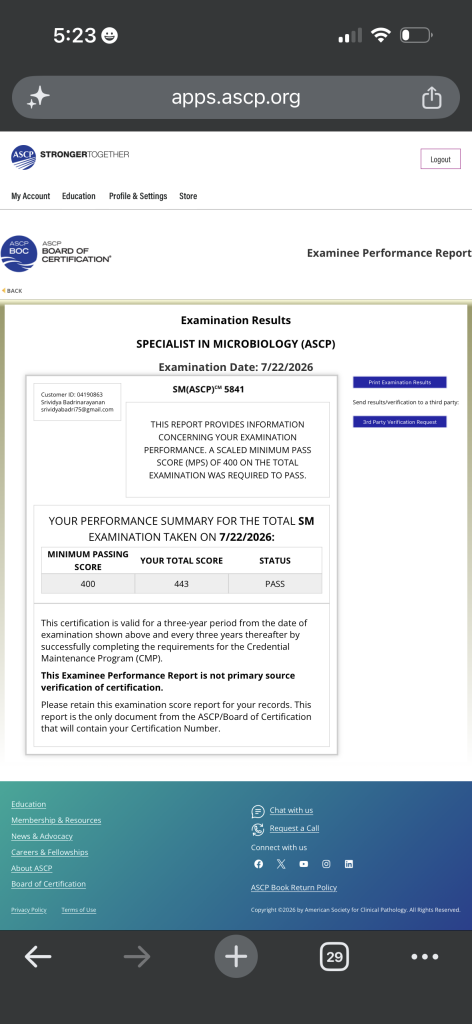
Highly recommend MLSIA Academy! I just passed my SM(ASCP) exam and couldn't have done it without this course. The high-yield study guides and realistic practice questions prepared me perfectly for the exam layout. The curriculum is concise, relevant, and worth every penny. Five stars!
MLS Academy is an excellent investment for anyone taking the SM(ASCP) exam. The depth of the microbiology content and management modules is fantastic. What sets this program apart is the quality of the resources and the responsiveness of the instructors. They truly care about student success. Thanks to their preparation tools, I felt confident going into the testing center and passed!
I enrolled in the MLSIA ASCP program to prepare for my certification exam. the lectures are organized and easy to follow and the study materials have helped me understand topics more clearly. I especially like having everything in one place. I am still preparing for my exam but so far the program has been very helpful.
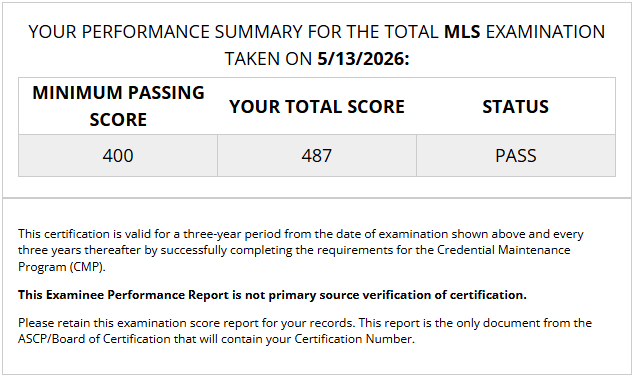
This course was the keystone to passing the MLS(ASCP) exam on 5/13/2026. I took the exam 3 times before taking the course. I found it to be a great help in bridging the gaps in the information. Its a hard exam with a lot of information. Before the MLSIA prep course i was using the Orange book and Labce but that wasn't enough. I felt i was just memorizing information rather than learning to understand. This prep course gave full lectures with all the information needed. The online quizzes are very nice.
highly recommend if you feel you lack a lot of the necessary knowledge.
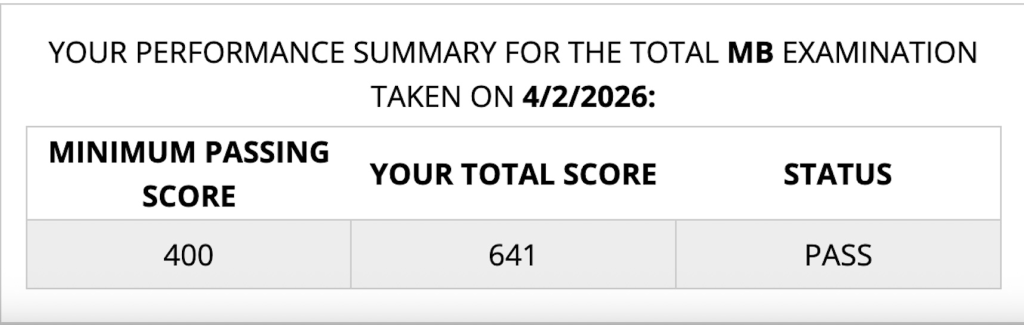
I passed exam with 641 score. The Q&A question bank for the preparation of MB-ASCP examination helped me greatly to solve many questions. However, the questions were not the same, but they helped me to select the topics and understand the content.
SM(ASCP) Exam Prep is the structured preparation framework designed to qualify experienced microbiology professionals for the ASCP Board of Certification Specialist in Microbiology (SM) credential, validating advanced diagnostic judgment, organism-level expertise, and supervisory-level decision-making in clinical microbiology laboratories.
This preparation applies to candidates entering the exam through multiple eligibility routes, including formal education combined with clinical experience or extended professional practice in microbiology. The exam is delivered through ASCP’s Computer Adaptive Testing (CAT) model and evaluates performance at the specialist level rather than routine bench execution.
SM(ASCP) Exam Content Areas & SM Preparation Focus
Every SM(ASCP) prep module for the SM exam is fully aligned with the official ASCP guidelines for the [current_date format='Y']SM(ASCP) Specialist in Microbiology Exam.
The SM(ASCP) certification exam emphasizes specialized microbiology domains as defined by the ASCP Board of Certification. These areas, most recently updated for the [current_date format='Y'], reflect the advanced technical expertise, critical reasoning, and laboratory management skills expected of a Specialist in Microbiology. The exam focuses on high-complexity testing, pathogen characterization, advanced identification techniques, and interpretation of results under strict biosafety and regulatory standards, rather than routine laboratory procedures or general molecular applications.
Content Area
Description
Examination Percentage (SM)
Preanalytic Procedures
Specimen collection, transport, processing, staining methods, and interpretation
What the SM(ASCP) Exam Requires of a Specialist in Microbiology
The SM(ASCP) exam measures whether a candidate can function independently as a microbiology authority within a clinical laboratory environment.
The exam evaluates advanced responsibilities that extend beyond organism identification. This includes interpretation of complex culture results, correlation of phenotypic and molecular findings, assessment of antimicrobial susceptibility patterns, and resolution of atypical or discordant cases.
Because the exam uses CAT, each response dynamically determines the difficulty of subsequent questions. This structure favors candidates who demonstrate consistent high-level reasoning across bacterial, mycobacterial, mycological, parasitological, and virological domains.
Success depends on applying microbiology principles under conditions that mirror real diagnostic pressure, not recalling isolated facts.
Core SM(ASCP) Content Expectations
The exam content reflects the professional scope of a Specialist in Microbiology and aligns with responsibilities encountered in reference laboratories, hospital microbiology departments, and supervisory roles.
Primary competency areas include:
Advanced bacteriology, including complex biochemical differentiation and resistance mechanisms
Mycobacteriology, with emphasis on slow-growing organisms and specialized identification methods
Medical mycology, including morphology-based and molecular correlations
Parasitology, focused on diagnostic differentiation and clinical relevance
Virology, including testing strategies and result interpretation
Laboratory management considerations as they intersect with microbiology practice
Questions are framed to assess judgment, prioritization, and outcome-based decisions rather than procedural recall.
What’s Included in SM(ASCP) Exam Prep
SM(ASCP) Exam Prep integrates learning, reinforcement, and performance validation in a sequence that mirrors how specialists operate in practice.
SM(ASCP) Live Course
Live instruction provides structured coverage of specialist-level microbiology concepts with real-time clarification of complex diagnostic scenarios. This format supports candidates who benefit from guided reasoning through advanced organism differentiation and case-based interpretation.
SM(ASCP) Self-Paced Course
The self-paced course allows experienced professionals to progress according to their familiarity with each domain. This flexibility aligns with working specialists who need focused reinforcement rather than introductory instruction.
SM(ASCP) Study Guide and Study Materials
The study guide distills exam-relevant microbiology concepts into concise, role-specific explanations. The study book expands on these principles, supporting deeper review where diagnostic reasoning requires reinforcement
SM(ASCP) Video Lessons
Video instruction visualizes morphology, growth patterns, and diagnostic workflows that are central to microbiology practice. This format supports recognition-based learning essential for organism identification and correlation.
Assessment Tools Aligned with Specialist-Level Evaluation
Assessment components are designed to condition candidates for CAT-based evaluation and specialist-level decision-making.
SM(ASCP) Q&A
The Q&A QBank develops analytical precision by requiring candidates to justify diagnostic conclusions and rule out plausible alternatives. This mirrors real laboratory decision pathways.
SM(ASCP) Quiz
Quiz-based assessments reinforce retention across microbiology domains and highlight knowledge gaps before high-stakes testing.
SM(ASCP) Practice Exams
Practice exams simulate the cognitive demand of the SM(ASCP) exam, requiring sustained accuracy across multiple content areas under exam-like conditions.
SM(ASCP) Mock Exams
The mock exam replicates CAT pressure by adapting question difficulty based on performance. This conditions candidates for pacing, confidence, and consistency at the specialist level.
How-to-Pass SM(ASCP) Exam Resources
Strategic guidance focuses on exam behavior, adaptive testing awareness, and response calibration appropriate for advanced-level certification.
How These Prep Formats Support the Specialist Role
Each preparation format aligns with how Specialists in Microbiology operate professionally. Learning resources reinforce conceptual mastery required for interpretation. Assessment tools validate readiness to apply that mastery under variable conditions. Mock testing confirms performance stability when question difficulty escalates.
This progression reflects the transition from knowledge acquisition to diagnostic authority.
ASCP Exam Authority and Testing Model
The SM(ASCP) exam is administered by the ASCP Board of Certification using Computer Adaptive Testing. CAT evaluates both correctness and consistency.
Early accuracy leads to more complex scenarios that require higher-order reasoning. Performance is judged against a predefined competency standard rather than against other candidates.
For Specialists in Microbiology, this structure emphasizes sustained expertise across all microbiology domains rather than isolated strengths.
Who This SM(ASCP) Exam Prep Is For
Microbiology professionals pursuing Specialist in Microbiology certification
Experienced technologists advancing into supervisory or consultative roles
Repeat candidates seeking structured remediation aligned with CAT behavior
International microbiology professionals aligning experience with ASCP standards
Working professionals balancing preparation with laboratory responsibilities
Each resource accommodates the professional maturity and diagnostic expectations of specialist-level candidates.
How SM(ASCP) Exam Prep Supports Passing Performance
Preparation is structured to build readiness through repetition, reinforcement, and validation.
Consistency across assessments signals readiness for CAT escalation
Targeted review reduces variability across microbiology subdisciplines
Mock exams confirm the ability to maintain performance under adaptive pressure
This approach aligns preparation with how the exam determines competency.
Have a question? Please fill out the form below to ask your question.
The SM(ASCP) exam certifies that a professional can function at an advanced specialist level in microbiology, demonstrating expertise in complex laboratory testing, pathogen analysis, and decision-making in clinical and public health microbiology laboratories.
SM(ASCP) stands for Specialist in Microbiology certified by the American Society for Clinical Pathology (ASCP). This credential represents mastery of advanced microbiology practices, including identification of unusual or rare pathogens, troubleshooting complex assays, and interpreting challenging laboratory data.
Candidates typically include experienced microbiology scientists, professionals with advanced laboratory training, and internationally trained microbiologists seeking ASCP specialist-level credentialing. Applicants are expected to have in-depth microbiology experience beyond standard scientist-level practice.
Specialists independently oversee complex microbiology testing, evaluate unusual culture and susceptibility results, perform advanced pathogen characterization, troubleshoot sophisticated assays, and ensure laboratory quality and compliance in high-complexity environments.
The exam covers bacteriology, mycology, parasitology, virology, antimicrobial susceptibility testing, molecular microbiology techniques, laboratory safety, quality assurance, and interpretation of advanced clinical microbiology scenarios.
Yes. The exam uses Computer Adaptive Testing, adjusting question difficulty based on performance. Candidates must demonstrate consistent specialist-level reasoning, technical skill, and problem-solving across all tested microbiology domains.
The exam evaluates advanced pathogen identification, complex data interpretation, troubleshooting of atypical microbiology results, application of quality systems, and the ability to make independent, evidence-based laboratory decisions.
SM preparation emphasizes specialist-level analysis, interpretation of rare or challenging microbiology cases, and integration of complex laboratory data, rather than standard scientist-level testing procedures. Candidates are expected to handle advanced problem-solving scenarios.
Structured review of advanced microbiology topics, case-based practice, examination of rare pathogen scenarios, and mock adaptive exams help candidates build specialist-level reasoning and decision-making skills.
They simulate real-world advanced microbiology scenarios, reinforce analytical reasoning, and prepare candidates to navigate adaptive testing pressures while maintaining accuracy in complex cases.
Experienced microbiologists, laboratory supervisors, specialists in clinical or public health microbiology, and professionals seeking recognition of their advanced technical expertise will benefit most from structured SM(ASCP) preparation resources.
Candidates must interpret atypical pathogen results, troubleshoot non-standard assays, integrate molecular and culture data, and apply quality and safety standards consistently in high-complexity scenarios.
It involves analyzing rare or unexpected microbial findings, determining appropriate follow-up testing, troubleshooting assay anomalies, and making independent decisions that ensure accurate and clinically meaningful laboratory outcomes.
Structured preparation organizes advanced microbiology knowledge, reinforces analytical reasoning through complex case studies, and builds confidence in navigating adaptive exam formats and challenging laboratory scenarios.