SBB(ASCP) Exam Prep - Courses, Study Materials and Question Banks
MLSIA SBB(ASCP) Exam Prep equips you with advanced serology and blood bank study tools, clear strategies, and expert guidance that turn uncertainty into confidence. Strengthen your mastery with targeted practice, structured plans, and support that keep you safe and fully prepared.
SBB(ASCP) Prep Courses, QBanks, and Study Materials
Every resource is designed to accelerate learning, reduce stress, and move you closer to earning the SBB(ASCP) credential that elevates your laboratory career. Step into the exam calm, focused, and ready to succeed.
$219.00Original price was: $219.00.$199.00Current price is: $199.00.
⭐Real Reviews & Testimonials⭐
Srividya badri
Verified Buyer
5/5
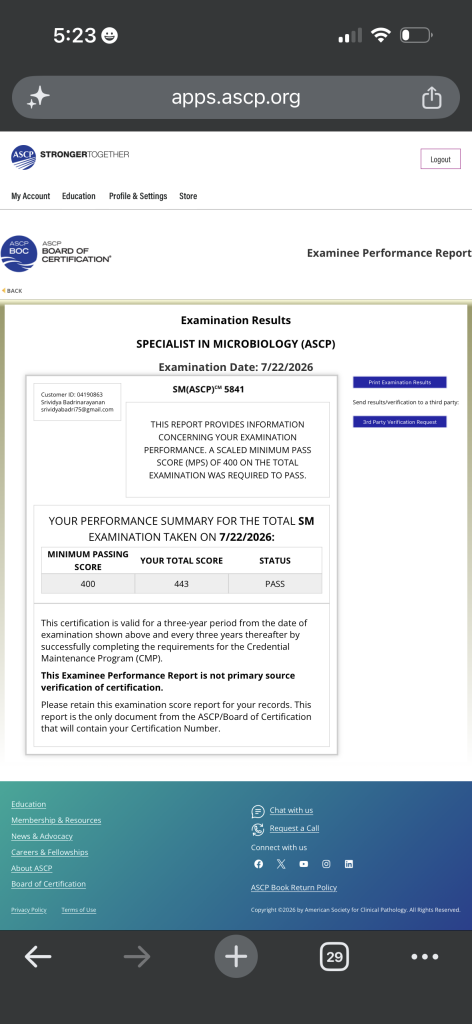
Highly recommend MLSIA Academy! I just passed my SM(ASCP) exam and couldn't have done it without this course. The high-yield study guides and realistic practice questions prepared me perfectly for the exam layout. The curriculum is concise, relevant, and worth every penny. Five stars!
MLS Academy is an excellent investment for anyone taking the SM(ASCP) exam. The depth of the microbiology content and management modules is fantastic. What sets this program apart is the quality of the resources and the responsiveness of the instructors. They truly care about student success. Thanks to their preparation tools, I felt confident going into the testing center and passed!
I enrolled in the MLSIA ASCP program to prepare for my certification exam. the lectures are organized and easy to follow and the study materials have helped me understand topics more clearly. I especially like having everything in one place. I am still preparing for my exam but so far the program has been very helpful.
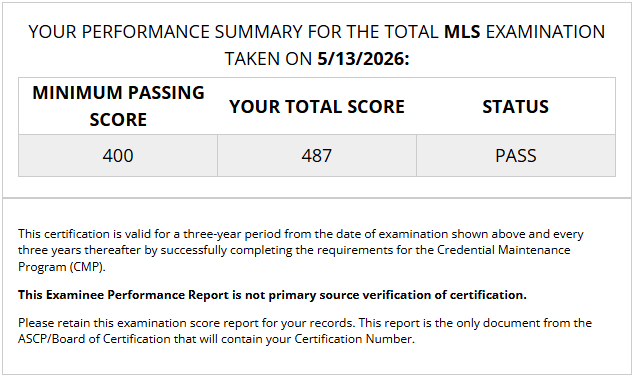
This course was the keystone to passing the MLS(ASCP) exam on 5/13/2026. I took the exam 3 times before taking the course. I found it to be a great help in bridging the gaps in the information. Its a hard exam with a lot of information. Before the MLSIA prep course i was using the Orange book and Labce but that wasn't enough. I felt i was just memorizing information rather than learning to understand. This prep course gave full lectures with all the information needed. The online quizzes are very nice.
highly recommend if you feel you lack a lot of the necessary knowledge.
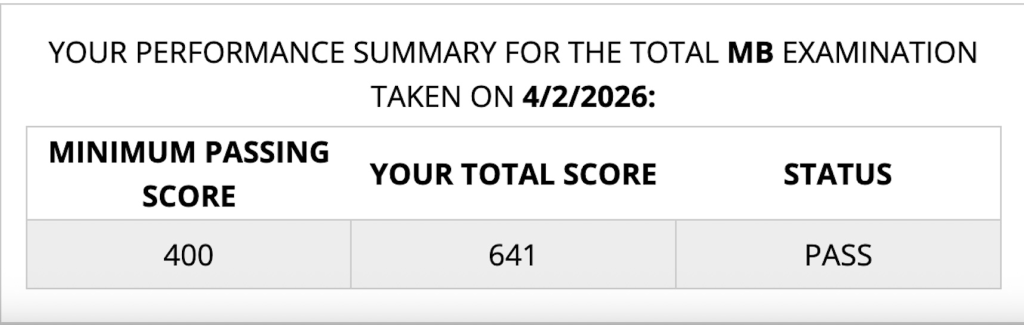
I passed exam with 641 score. The Q&A question bank for the preparation of MB-ASCP examination helped me greatly to solve many questions. However, the questions were not the same, but they helped me to select the topics and understand the content.
SBB(ASCP) Exam Prep is a structured set of educational and assessment resources designed to prepare experienced blood bank professionals for the ASCP Board of Certification Specialist in Blood Banking examination, a Computer Adaptive Testing (CAT) exam that evaluates advanced responsibility, judgment, and systems-level decision-making in transfusion medicine.
This preparation is intended for candidates who meet ASCP eligibility routes through accredited education, specialist-level training programs, or qualifying professional experience, and who are preparing to demonstrate mastery beyond generalist practice.
The SBB(ASCP) credential validates readiness to function as a senior authority in blood bank and transfusion services, including consultation, problem resolution, policy oversight, and complex compatibility assessment across clinical and donor settings.
SBB(ASCP) Exam Content Areas & SBB Preparation Focus
Every SBB(ASCP) prep module for the SBB exam is fully aligned with the official ASCP guidelines for the [current_date format='Y']SBB(ASCP) Specialist in Blood Banking Exam.
The SBB(ASCP) certification exam emphasizes advanced transfusion medicine and immunohematology domains as defined by the ASCP Board of Certification. These areas, most recently updated for the [current_date format='Y'], reflect the specialized knowledge, technical expertise, and laboratory leadership skills expected of a Specialist in Blood Banking. The exam focuses on complex serologic and molecular testing, donor and component management, transfusion strategy, and laboratory operations, rather than routine blood banking or general laboratory procedures.
Content Area
Description
Examination Percentage (SBB)
Blood Products
Donor management, processing, storage, blood component types, component quality control
What the SBB(ASCP) Exam Requires of a Specialist in Blood Banking
The SBB(ASCP) examination evaluates how candidates apply blood banking principles at a specialist level rather than how well they recall isolated facts. Exam content reflects responsibilities such as resolving serologic discrepancies, directing immunohematology investigations, evaluating transfusion reactions, managing donor testing strategies, and ensuring regulatory compliance across blood utilization systems. Because the exam is delivered using Computer Adaptive Testing, each response influences the difficulty of subsequent questions. This structure prioritizes consistency of expert-level judgment under pressure rather than broad but shallow coverage. Preparation therefore must train candidates to:
Interpret incomplete or conflicting laboratory data
Select defensible actions when multiple options appear plausible
Apply standards, guidelines, and policies to real operational scenarios
Maintain accuracy as cognitive load increases
Scope of Knowledge Assessed on the SBB(ASCP) Exam
The SBB(ASCP) exam content aligns with the professional scope of practice expected of a Specialist in Blood Banking, including:
Advanced immunohematology and antibody identification
Complex compatibility testing and transfusion decision support
Transfusion reaction investigation and risk mitigation
Donor testing, component preparation, and product modification
Quality systems, validation, and regulatory compliance
Consultation, education, and leadership within transfusion services
These domains are assessed through scenario-driven questions that reflect supervisory and consultative responsibilities rather than bench-level task execution.
What’s Included in SBB(ASCP) Exam Prep
SBB(ASCP) Exam Prep is structured to mirror how Specialists in Blood Banking learn, apply, and verify knowledge in professional practice.
SBB(ASCP) Live Course
Live instruction focuses on expert reasoning, case-based analysis, and real-time application of standards. This format supports candidates who benefit from guided interpretation of complex scenarios and clarification of nuanced decision pathways common in transfusion services.
SBB(ASCP) Self-Paced Course
Self-paced modules allow candidates to progress through advanced topics on their own schedule. This approach supports working professionals who must balance preparation with supervisory or consultative responsibilities.
SBB(ASCP) Study Guide and Materials
Written materials emphasize structured reasoning over memorization. Content is organized around decision points, regulatory expectations, and failure modes encountered in specialist practice.
SBB(ASCP) Video Lessons
Video instruction reinforces visual pattern recognition in immunohematology, workflow logic in transfusion services, and expert commentary on why certain actions are defensible under ASCP exam conditions.
Assessment Tools Aligned to CAT-Based Evaluation
SBB(ASCP) Q&A
Q&A items train candidates to evaluate stem relevance, eliminate unsafe options, and select responses consistent with specialist accountability.
SBB(ASCP) Quiz
Short-form quizzes reinforce accuracy and recall while building speed and confidence across high-frequency specialist topics.
SBB(ASCP) Practice Exams
Practice exams simulate CAT logic, requiring sustained expert-level performance across multiple content domains.
SBB(ASCP) Mock Exams
The mock exam replicates testing pressure and adaptive behavior, helping candidates evaluate readiness under realistic cognitive load.
How These Resources Support Passing the SBB(ASCP) Exam
The progression from learning to assessment reflects how the ASCP exam evaluates specialists. Instruction establishes expert frameworks. Question banks train decision-making consistency. Mock exams validate readiness to maintain accuracy as question difficulty escalates. This alignment ensures preparation is measured against the same expectations used by the ASCP Board of Certification to award the SBB credential.
ASCP Format and Expectations
The SBB(ASCP) exam is administered by the ASCP Board of Certification using Computer Adaptive Testing. The exam does not reward partial knowledge or isolated memorization. It evaluates whether a candidate consistently demonstrates specialist-level reasoning, risk awareness, and adherence to professional standards. Performance reflects readiness to function independently as a Specialist in Blood Banking across clinical, donor, and regulatory contexts.
Who SBB(ASCP) Exam Prep Is For
This preparation is designed for:
Blood bank professionals pursuing Specialist in Blood Banking certification
Graduates of accredited SBB programs preparing for first-time testing
Experienced transfusion service supervisors advancing credential level
Repeat test takers seeking to correct decision-making inconsistencies
International candidates aligning experience with ASCP exam expectations
Each resource supports candidates at different stages while maintaining the same specialist-level performance standard.
Have a question? Please fill out the form below to ask your question.
The SBB(ASCP) exam certifies that a professional can operate at a specialist level in blood banking, performing advanced immunohematology testing, managing transfusion services, resolving complex compatibility issues, and making independent clinical laboratory decisions.
SBB(ASCP) stands for Specialist in Blood Banking certified by the American Society for Clinical Pathology (ASCP). It reflects advanced mastery in immunohematology, complex antibody identification, and transfusion service management.
Candidates are typically experienced blood banking scientists, transfusion medicine professionals, and internationally trained immunohematology specialists seeking advanced ASCP certification. Eligibility usually requires prior experience in BB(ASCP)-level practice.
SBB professionals oversee transfusion services, perform advanced antibody workups, manage complex compatibility testing, troubleshoot atypical cases, implement quality systems, and provide expert guidance for clinical transfusion decisions.
The exam covers 6 areas including Blood Products, Blood Group Systems, Immunology and Physiology, Serologic & Molecular Testing, Transfusion Practice and laboratory Operations.
Yes. The exam uses Computer Adaptive Testing (CAT), requiring candidates to demonstrate specialist-level reasoning, advanced problem-solving, and consistent decision-making across high-complexity immunohematology scenarios.
The exam evaluates advanced antibody and antigen analysis, resolution of complex transfusion compatibility problems, troubleshooting rare serologic scenarios, application of quality systems, and independent decision-making in transfusion medicine.
SBB preparation focuses on specialist-level case management, complex problem-solving, and integration of immunohematology theory with transfusion service operations, rather than standard scientist-level procedural practice.
They allow candidates to simulate advanced transfusion scenarios, strengthen analytical and troubleshooting skills, and develop proficiency in decision-making under adaptive testing conditions.
Experienced blood banking scientists, laboratory supervisors, transfusion service managers, and professionals seeking specialist-level recognition in immunohematology benefit most from structured SBB(ASCP) preparation resources.
Candidates face challenges such as interpreting rare antibody reactions, managing complex transfusion cases, troubleshooting atypical serologic results, and applying safety and quality standards in high-complexity transfusion scenarios.
It involves analyzing complex antibody-antigen interactions, resolving transfusion compatibility conflicts, troubleshooting unusual laboratory findings, and making independent decisions that ensure safe and effective patient transfusions.
Organized preparation develops in-depth knowledge of immunohematology, reinforces advanced problem-solving skills through case-based practice, and builds confidence in decision-making under CAT conditions and complex laboratory scenarios.
Effective strategies include reviewing advanced immunohematology content, practicing case-based scenarios, analyzing rare antibody reactions, and taking mock CAT exams to build confidence in specialist-level reasoning.