H(ASCP) Exam Prep - Courses, Study Materials and Question Banks
MLSIA H(ASCP) Exam Prep equips you with focused hematology study tools, clear strategies, and expert guidance that transform uncertainty into confidence. Strengthen your skills with targeted practice, structured study plans, and reliable support that keep you safe and fully prepared.
H(ASCP) Prep Courses, QBanks, and Study Materials
Step into the exam calm, ready, and empowered to succeed.
$219.00Original price was: $219.00.$199.00Current price is: $199.00.
⭐Real Reviews & Testimonials⭐
Srividya badri
Verified Buyer
5/5
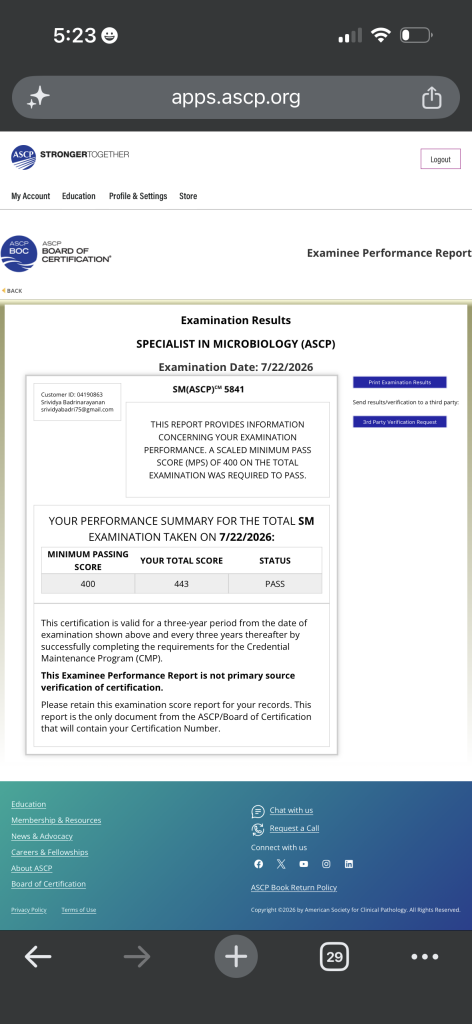
Highly recommend MLSIA Academy! I just passed my SM(ASCP) exam and couldn't have done it without this course. The high-yield study guides and realistic practice questions prepared me perfectly for the exam layout. The curriculum is concise, relevant, and worth every penny. Five stars!
MLS Academy is an excellent investment for anyone taking the SM(ASCP) exam. The depth of the microbiology content and management modules is fantastic. What sets this program apart is the quality of the resources and the responsiveness of the instructors. They truly care about student success. Thanks to their preparation tools, I felt confident going into the testing center and passed!
I enrolled in the MLSIA ASCP program to prepare for my certification exam. the lectures are organized and easy to follow and the study materials have helped me understand topics more clearly. I especially like having everything in one place. I am still preparing for my exam but so far the program has been very helpful.
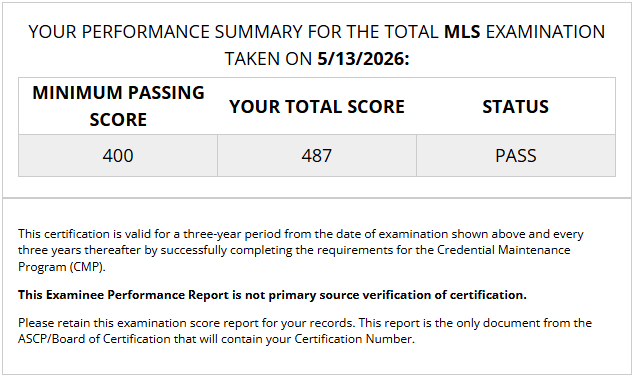
This course was the keystone to passing the MLS(ASCP) exam on 5/13/2026. I took the exam 3 times before taking the course. I found it to be a great help in bridging the gaps in the information. Its a hard exam with a lot of information. Before the MLSIA prep course i was using the Orange book and Labce but that wasn't enough. I felt i was just memorizing information rather than learning to understand. This prep course gave full lectures with all the information needed. The online quizzes are very nice.
highly recommend if you feel you lack a lot of the necessary knowledge.
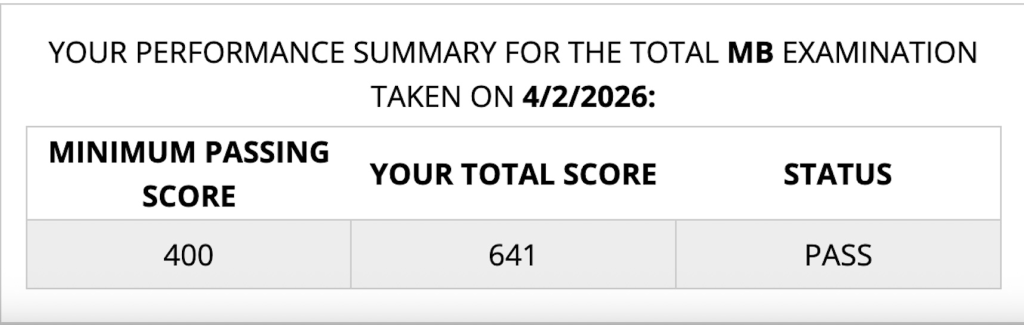
I passed exam with 641 score. The Q&A question bank for the preparation of MB-ASCP examination helped me greatly to solve many questions. However, the questions were not the same, but they helped me to select the topics and understand the content.
H(ASCP) Exam Prep is a structured set of educational resources designed to prepare professional Scientists in Hematology for the ASCP Board of Certification’s Hematology (H) exam. These resources support candidates in demonstrating the knowledge, analytical reasoning, and laboratory decision-making required to perform hematology testing at the scientist level.
Eligibility includes individuals with an accredited degree in medical laboratory science or related disciplines, relevant hematology experience, and those pursuing certification through alternate pathways recognized by ASCP.
Preparation materials are aligned with the Computer Adaptive Testing (CAT) format, ensuring that study reflects the scope and responsibility of a practicing Hematology scientist.
H(ASCP) Exam Content Areas & H Preparation Focus
Every H(ASCP) prep module for the H exam is fully aligned with the official ASCP guidelines for the [current_date format='Y']H(ASCP) Scientist in hematology Exam.
The H(ASCP) certification exam is structured around core hematology domains as defined by the ASCP Board of Certification. These domains, most recently updated for the [current_date format='Y'], reflect the knowledge, technical proficiency, and analytical skills required of a Medical Laboratory Hematologist. The emphasis is on understanding blood physiology, evaluating hematologic disease states, performing laboratory testing accurately, and interpreting results in the context of clinical conditions, rather than molecular or microbiology procedures.
Content Area
Description
Examination Percentage
Hematology Physiology
Production, destruction, and function of blood, body fluids, and bone marrow
10–15%
Hematology Disease States
Qualitative and quantitative abnormalities of erythrocytes, leukocytes, and platelets
What the H(ASCP) Exam Requires of a Scientist in Hematology
The H(ASCP) exam evaluates a scientist’s ability to interpret hematology test results, perform and troubleshoot advanced laboratory procedures, and apply clinical reasoning to patient care scenarios. It emphasizes:
Automated and manual hematology testing: CBC, differential counts, coagulation studies
Laboratory management tasks: Quality control, instrument calibration, and workflow optimization
Clinical correlation: Linking laboratory results with pathophysiology, including anemias, leukemias, and coagulation disorders
Problem-solving under CAT conditions: Dynamic question difficulty adapts to the candidate’s demonstrated proficiency, reflecting real-world decision-making expectations
Success requires both conceptual understanding and applied knowledge, mirroring the daily responsibilities of a hematology scientist.
What’s Included in H(ASCP) Exam Prep
Effective preparation combines multiple formats that reinforce theory, practice, and exam readiness:
H(ASCP) Live Course
Instructor-led sessions covering all hematology content areas
Interactive case studies simulating laboratory decision-making
Focused learning paths on hematology principles, instrumentation, and clinical correlations
H(ASCP) Study Guide and Study Materials
Concise, role-specific explanations of hematology testing, normal ranges, and pathological interpretations
Reference charts and tables for rapid review
H(ASCP) Video Lessons
Demonstrations of laboratory techniques, instrument operation, and workflow scenarios
Visual reinforcement of complex hematology concepts
H(ASCP) Q&A
Targeted questions that test applied knowledge and decision-making under exam conditions
Immediate feedback with explanations connecting answers to professional practice
H(ASCP) Quizzes
Short, topic-specific quizzes for incremental knowledge checks
Ideal for reinforcing weak areas identified during study sessions
H(ASCP) Practice Exam
Full-length exams reflecting CAT structure and time constraints
Prepares candidates for pacing, concentration, and endurance
H(ASCP) Mock Exams
Simulates testing pressure in a realistic environment
Builds familiarity with question formats and exam interface
How-to-Pass H(ASCP) Exam Resources
Strategic guidance on interpreting complex questions
Study planning and time management techniques tailored to hematology content
Exam Authority and Structure
The ASCP H exam is delivered as a Computer Adaptive Test (CAT), evaluating both knowledge depth and practical reasoning. Questions increase or decrease in difficulty based on candidate responses, simulating decision-making scenarios encountered in a professional hematology laboratory. Key exam components include:
Hematology instrumentation and laboratory automation
Peripheral blood and bone marrow analysis
Coagulation testing and troubleshooting
Interpretation of abnormal results with clinical significance
Preparation aligns with these competencies, ensuring that candidates practice the critical thinking and technical skills expected of certified hematology scientists.
Who This Is For
H(ASCP) Exam Prep is intended for:
First-time candidates with a degree in medical laboratory science or related fields seeking certification
Repeat candidates needing targeted reinforcement of weak content areas
International professionals pursuing ASCP certification to validate hematology expertise
Working laboratory scientists balancing study with professional responsibilities
Each resource is tailored to replicate the role-specific knowledge, laboratory judgment, and exam behavior necessary for certification.
How These Materials Support Passing the Exam
Live instruction builds interactive problem-solving and clinical reasoning
Self-paced modules allow repeated exposure to complex concepts
QBanks and mock exams replicate CAT dynamics, enhancing familiarity with adaptive difficulty and decision-making under pressure
Study guides and videos consolidate procedural knowledge and laboratory workflow
This integrated approach strengthens readiness, consistency, and confidence in approaching the H(ASCP) exam.
Have a question? Please fill out the form below to ask your question.
The H(ASCP) exam certifies that a professional can independently perform and interpret hematology testing, analyze blood cell morphology, evaluate coagulation studies, and make clinical laboratory decisions at the scientist level.
H(ASCP) stands for Scientist in Hematology certified by the American Society for Clinical Pathology (ASCP). It indicates advanced proficiency in hematology techniques, blood cell analysis, and laboratory problem-solving. It was formerly known as the Technologist in Hematology certification, reflecting its transition from technologist to scientist designation.
Candidates include graduates of hematology or clinical laboratory science programs, experienced hematology scientists, and internationally trained professionals meeting ASCP requirements for specialist-level certification.
H(ASCP) professionals perform independent analysis of blood and bone marrow specimens, evaluate cell morphology, interpret coagulation and hematology test results, troubleshoot instrumentation issues, and ensure adherence to laboratory quality and safety standards.
The exam covers Hematology Physiology, Hematology Disease States, Hematology Laboratory Testing, Hemostasis and Laboratory Operations.
Yes. The exam uses Computer Adaptive Testing (CAT), requiring candidates to demonstrate consistent scientist-level reasoning, analytical skills, and problem-solving across hematology domains.
The exam evaluates the ability to analyze blood cell morphology, interpret coagulation studies, troubleshoot hematology instrumentation, apply quality control measures, and make independent, clinically relevant decisions.
H(ASCP) preparation emphasizes scientist-level analysis, including hematology interpretation, coagulation reasoning, and troubleshooting advanced lab tests, rather than generalist-level laboratory procedures or entry-level science knowledge.
Effective strategies include structured review of hematology topics, practicing morphology-based and coagulation scenarios, mock CAT exams, and case-based problem-solving exercises to develop specialist-level reasoning.
Practice exams allow candidates to simulate real-world hematology challenges, strengthen analytical and troubleshooting skills, and build confidence in decision-making under adaptive testing conditions.
Graduates of hematology programs, experienced laboratory scientists, hematology supervisors, and professionals seeking specialist-level certification in hematology benefit most from structured preparation.
Candidates face challenges such as interpreting complex blood cell morphologies, analyzing coagulation data, troubleshooting instrumentation issues, and applying quality standards consistently in high-complexity hematology scenarios.
It involves analyzing blood and bone marrow specimens, evaluating abnormal findings, troubleshooting testing procedures, and making independent decisions that ensure accurate, clinically meaningful laboratory results.
Organized preparation develops a deep understanding of hematology principles, reinforces problem-solving through case-based practice, and builds confidence in specialist-level decision-making under CAT exam conditions.